


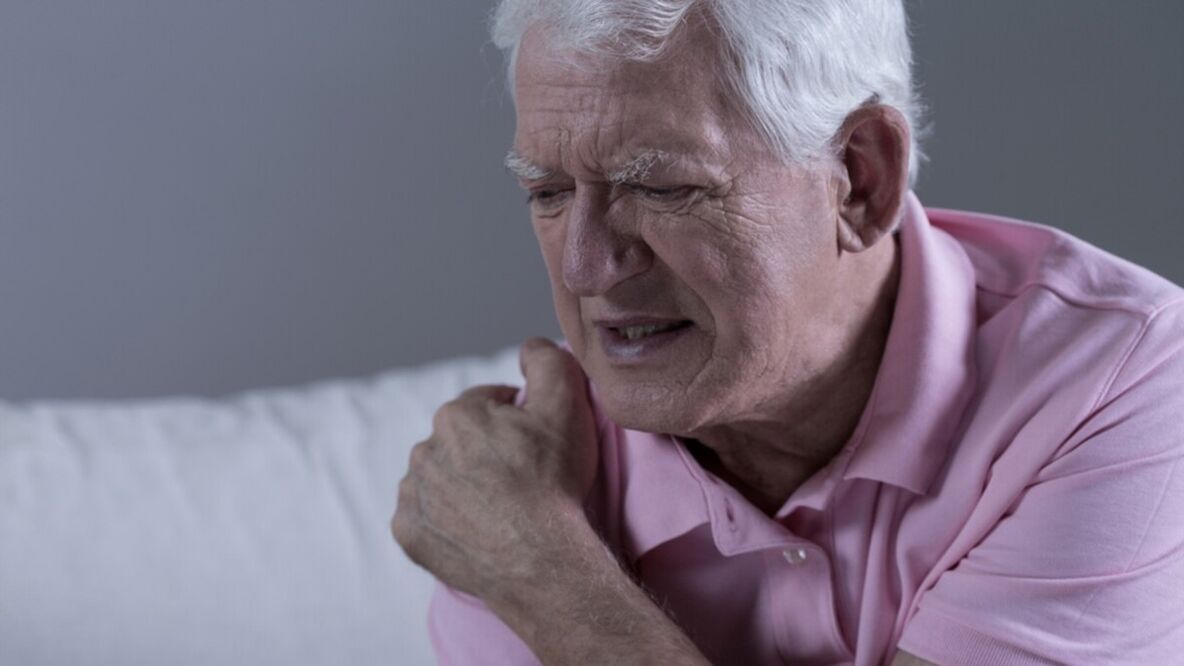
Arthrosis of the shoulder joint is accompanied by swelling, severe pain in the shoulder and limitation of movements.The causes and symptoms of the disease, available treatment methods and ways to help at home will be discussed later in the article.
What is shoulder arthrosis?
The shoulder joint is very complex in structure and is the most mobile, providing the human body with the most complete range of movements.The shoulder joint capsule can stretch very strongly, thanks to which a person can raise the arm vertically and perform rotational movements with it.This action weakens the ligaments, and as a result of the sharp flexion of the tendons, they often experience mild ischemia.
The main danger of its destruction and the development of pathology is the lack of nutrition of the joint tissue.
The disease, which is primarily expressed by the degeneration of the tissues of the shoulder joint, is called arthrosis of the shoulder joint or shoulder arthrosis.Biomechanics of the shoulder is based on the perfect functioning of all components: normal nerve conduction, good blood supply, perfect anatomical structure.Violation of any of these conditions always leads to deformation of internal tissues, discomfort, restriction of movements and pain.
Arthrosis (or osteoarthritis) is not primarily an inflammatory, but a degenerative disease.It is associated with ischemic processes caused by various causes in the surrounding tissues.
As a result, the nutrition of the joint is disturbed, the thin and elastic layer of hyaline cartilage covering the head of the bone becomes thinner.The less elastic and thinner hyaline cartilage makes normal movement difficult, which leads to narrowing of the joint space.
This phenomenon forces the body to move and bone spurs called osteophytes form along the edges of the joint.It is osteophytes with sharp edges that damage muscles and ligaments, causing chronic, low-grade inflammation.
The main danger of osteoarthritis is that a small limitation in the mobility of the arm leads to a constant decrease in the range of motion.
Without movement, the shoulder begins to suffer from the accumulation of salts in the tissues surrounding the joint and the deterioration of the nutrition of the joint tissues.Over time, this is fraught with the formation of joint contractures - limitation of movement or complete loss of shoulder mobility and disability for the patient.
Causes of shoulder arthrosis
The only cause of shoulder arthrosis is deep ischemia, that is, acute or gradual deterioration of blood supply to certain areas of the tissue and depletion of nutrition in the joint.However, this reason is caused by factors that may exist separately or simultaneously in the anamnesis:
- Shoulder injuries.These can be obvious injuries from a car accident or fall, or hidden tears of muscles and ligaments sustained during sports training or hard work.Any joint damage always has the ability to remind itself, because the affected areas do not return to their full size, and their permeability is constantly disturbed.The body can successfully cope with this for several years or decades before aging begins.
- Age-related changes in the body.
- Infectious attacks that cause arthritis.
- Metabolic and hormonal disorders are also often related to age.
- Hereditary or genetic predisposition.
Stages and symptoms of arthrosis of the shoulder joint
The disease goes through several stages in its development.Since osteoarthritis is a chronic disease that progresses rather slowly, most patients ignore the first stage, when they can most effectively fight joint deformation.
- Symptoms of the first stage.For the first time, the patient may feel some discomfort when moving the hand when the hyaline cartilage is already thinned.A sharp swing or jump is not accompanied by pain, which is explained by the absence of nerve endings in the cartilage and its destruction does not cause pain.But sometimes in the evening or near the end of the training, the pain in my shoulder starts to bother me.Often it is not paid attention to, it is associated with muscle pain or neuralgia.However, the disease began almost asymptomatically, and if urgent measures are not taken, it passes into the second stage.
- Symptoms of the second stage.If the patient feels pain accompanied by a clearly audible click while moving his arm, this means that osteophytes have formed in the joint.From this moment on, the shoulder is constantly damaged by the sharp edges of the bony protrusions, causing inflammation of the surrounding tissues.It is expressed by morning stiffness that disappears only after joint development, or pain during ordinary physical activity or evening fatigue.
A person's well-being deteriorates because the source of chronic inflammation in the body affects the general condition.At night, in humid weather and in the off-season, the joint may hurt more.
The patient sharply limits the volume and amplitude of arm movements, he cannot raise more than ninety degrees in both the frontal and lateral planes.This leads to muscle atrophy and significant deterioration of joint tissue nutrition.
- Symptoms of the third stage.Usually, if the patient goes to the doctor in the third stage of the disease, he practically cannot move his arm.The arm does not rise, does not move to the side, the joint swells and grows.Muscle atrophy, the pain syndrome is so severe that when you try to raise your hand, tremors appear in your fingers.In most cases, there are contractures in the shoulder joint, "frozen shoulder" syndrome.

Methods of treatment of shoulder arthrosis
In fact, it is impossible to treat arthrosis, and even more so, it is impossible to do it at home.This disease is so dependent on many internal and external factors that it almost never has a root cause.
But the good news for patients in the first and second stages of the disease is that the development of arthrosis can be stopped.That is why doctors insist on early diagnosis of the disease and the beginning of shoulder arthrosis treatment, when the articular tissue is only partially destroyed, there are no osteophytes, and you can try to restore normal joint nutrition.
Conservative therapy
The treatment of arthrosis always has two goals: to relieve pain and, if possible, to restore the joint supply with substances necessary for normal functioning.

- The supply of nutrients to the tissues depends on what the patient eats.Diet for arthrosis should exclude salt and alcohol.Meat products and vegetables containing purine bases, which increase the level of uric acid in the body, are also undesirable.Steamed milk and vegetable dishes are recommended.
- Combine drugs with glucosamine and chondroitin, as well as collagen, which nourishes joint tissue.And the daily consumption of gelatin in the form of jelly helps to enrich the menu with animal collagen.
- Local application of various warming, anti-inflammatory and chondroitin-containing ointments and balms activates blood circulation in the tissues surrounding the joint.
- If the pain syndrome is not severe, the use of non-steroidal anti-inflammatory drugs is not recommended.If hand movements are accompanied by severe pain, NSAIDs can relieve pain and reduce inflammation.These medications will help reduce pain.
- If the shoulder swells and the inflammatory process starts there, rubbing with ointment compresses or gels applied at night has an excellent effect.
- Therapeutic exercises are an important component of successful shoulder arthrosis treatment.However, it is not recommended to overload the joint, as improperly distributed forces can lead to the rapid destruction of hyaline cartilage.
Therapeutic exercises for shoulder arthrosis and rules for its implementation
Special exercises will help develop the joint and give it mobility.You can do gymnastics at home.When performing the exercises, the basic rules should be:
- regularity, that is, you should exercise at least 15 minutes every day;
- perform the exercises smoothly and without much effort.This is necessary to avoid further damage to joint structures;
- getting spiritual pleasure during physical activity that will help to normalize the patient's emotional state.
Physiotherapy exercises where hand movements do not cause pain are recommended.They are performed slowly, forcing the ligaments and muscles to warm up and gradually stretch.
- We offer the simplest and most useful exercises for arthrosis of the shoulder joint:
- Sitting in a chair, put your hands on your knees.Make circular movements with your shoulders: 5 times forward, then 5 times back.
- Raise your arms straight up, pull your shoulders and shoulder blades back as far as possible.Hold for a few seconds, then lower.Repeat 5-7 times.
- Extend your arms straight, palms down, to the sides.Bend your hands at the wrist joints, fingers should face up.Make circular movements with your shoulders: 5 times forward, then 5 times back.
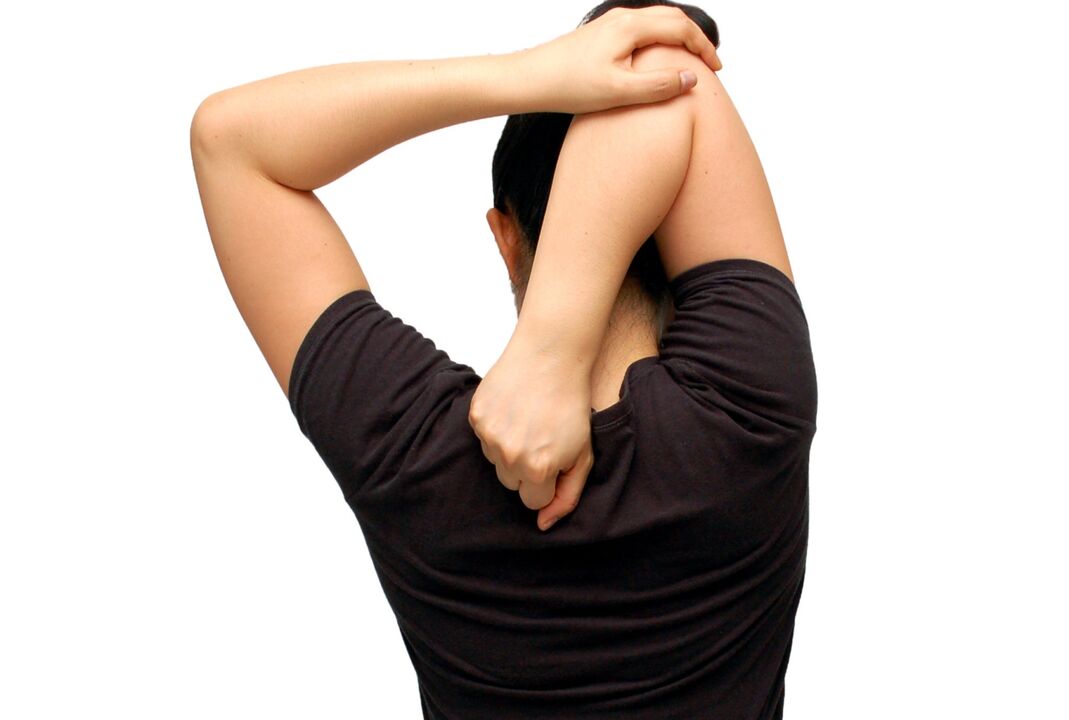
- Raise your bent arms above your head, fingers of one on the elbows of the opposite hand.Pull your arms back smoothly until you feel a stretch in the shoulder joint.Perform the exercise 5-7 times.
- Place the palms of both hands behind your head with the backs of your hands, fingers pointing down.Move your hands so that your palms move along your back to the area between your shoulder blades.Repeat the exercise 5-7 times.
- Place your left hand on the elbow of your right, move your right hand behind your left shoulder as far as possible until you feel a stretch in the shoulder joint.Perform the exercise 5-7 times.Switch hands and repeat the exercise for the other hand.
In the treatment of arthrosis of the shoulder joint, the following are considered effective: manual therapy, physiotherapy and sanatorium-spa treatment.The use of traditional medical methods is also considered justified.
Traditional healing methods and home help
The main folk remedy for the treatment of arthrosis of the shoulder joint is herbal medicine, which allows you to use dry herbs and herbal decoctions for compresses, to prepare ointments and rubs at home, to normalize metabolism and restore nutrition of the joint to reduce pain.
- Ointment.Take 10 grams of dried leaves of hops, sweet clover, St. John's wort.Finely chop the herbs and mash them together, add the vaseline and mix all the ingredients well.Apply the prepared ointment to the shoulder area.This will help reduce pain and inflammation in the joint.
- friction.Add five parts vodka or alcohol to one part crushed wild rosemary flowers.Then the medicine should be brewed for 24 hours in a warm, dark place.Tincture is used externally to rub the affected joints.
- meekPour corn silk (2 tablespoons) into two glasses of water, boil for 10 minutes, filter and drink one tablespoon four times a day.
- Compress.For the compress, you need to brew 30 grams of dry oatmeal in two glasses of water.Apply the prepared mixture on the painful shoulder for 30 minutes.
Alternative treatment of shoulder arthrosis
- Manual methods - massage, manual therapy sessions, osteopathy - allow to remove muscle blocks, tension and spasms, release blood vessels and nerves leading to the joint.
- Physiotherapy, especially shock wave therapy, balneotherapy, mud therapy and other methods are not recommended to be used during exacerbation, that is, when there is an active inflammatory process in the joint.
- Remission is an excellent reason for a sanatorium treatment course, after which continuous improvement is observed.
Surgical treatment of osteoarthritis of the shoulder
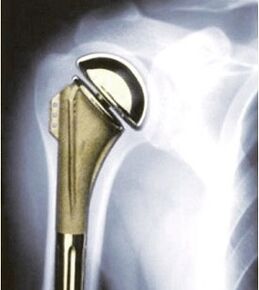
In cases of severe pain that prevents the patient from leading a normal life, the doctor may recommend surgery.
Most often, prostheses are performed, that is, the destroyed joint is replaced with an endoprosthesis.If possible, they perform a partial arthroplasty, replacing only part of the shoulder joint.
Surgery is rarely resorted to, because any surgical intervention, especially related to the installation of an intra-articular prosthesis, can cause complications and a long recovery period.
Osteoarthritis of the shoulder joint is an insidious and dangerous disease in which a person's motor activity is impaired and quite severe pain is noted.
It is important to treat this disease in time at the first small symptoms, to prevent further destruction of the joint.
The patient should remember that the successful treatment of osteoarthritis depends mainly on his efforts and activity, not on drugs.